Knowledge Factories


Before the industrial revolution, individuals made most of the physical goods.
After it, factories did.
Before the AI revolution individuals did most of the knowledge work.
After it, knowledge factories will.
Here's what that means, and how you can benefit.
What is a knowledge factory?
A knowledge factory is a system that automates cognitive labor to produce knowledge work at scale.
Physical factories automate manual labor with machines powered by electricity.
Knowledge factories automate cognitive labor with agents powered by AI.
What this means for the future of work
Today's knowledge workers share a lot in common with the artisans of the past.
Instead of the cobbler or the blacksmith producing 1 shoe or sword at a time, it's the lawyer or the coder writing one contract or line of code at a time.
AI is automating the cognitive labor of the knowledge worker like electricity automated the manual labor of the artisan.
Those that succeed in this new AI powered future will move from working on the thing (for example the contract or the code) to working on the thing that makes the thing (the knowledge factory).
How to build a knowledge factory
Unlike the industrial age, you don't need tons of capital to build a knowledge factory.
The ingredients are available to everyone, and at a price almost anyone can afford.
Here's what you need:
- AI model(s) to power your knowledge factory
- Agent(s) to do the work of your knowledge factory
- Connections to the systems and tools your agents need to accomplish their tasks
- Operating procedures that tell the AI and your agent(s) what you want them to do
- A feedback mechanism the AI can use to know if the work has been done as instructed.
The AI models and the agents are quickly becoming commodities. OpenAI's Codex, Anthropic's Claude Code, Google's Antigravity all give you the AI and the agent capabilities you need starting at just $20 a month.
And learning how to use them is about as simple as it gets. You just ask the tool and it will tell you.
So, perhaps surprisingly to most people, it's not the AI or the agent that makes a successful knowledge factory.
It's how your knowledge factory is structured so that it can do the knowledge work it is designed to do.
The operating procedures that you give to your knowledge factory, and the connections to the systems and data it uses to accomplish its work.
And no one is in a better position to make those connections and create those operating procedures than the people who are actually doing the work.
You just need to switch your mindset from working on making the thing yourself, to working on the thing that can make the thing for you - your knowledge factory.
Example
My company BrainDrive makes a personal AI system you own, and that is designed to help you define and reach your goals.
Instead of spending time writing the code of the system by hand, we work on the knowledge factory that writes the code for us.
Everyone has access to the AI and agents we use to write that code. But only we have access to all of the operating procedures and connections our agents have that make that code unique to BrainDrive.
And it's not just how the BrainDrive knowledge factory writes code. It's also how we plan and prioritize our work, the project management, the marketing, and everything else we need to do in order to have a successful project and company.
We still do things by hand. But when it's a recurring task, our goal is to document how we do it, and work with our AI to automate and integrate this new capability into our knowledge factory.
So here's where this leaves you.
Pick one thing you do over and over. The weekly report. The same kind of email. The performance review.
As you go about doing that work, write down the steps you would give to someone else if you wanted them to do the work for you. And what connections/systems they would need access to in order to do it.
Give this to your agentic AI system of choice (Codex, Claude Code, Antigravity etc) and ask it what else it needs from you in order to do this work for you in the future.
Make this the first "machine" in your knowledge factory. And next time instead of doing it by hand, have the knowledge factory do it for you instead.
But don't forget. The key is not just to do it faster, it is to do it at the same or hopefully even higher quality than it would be done if you were doing it by hand.
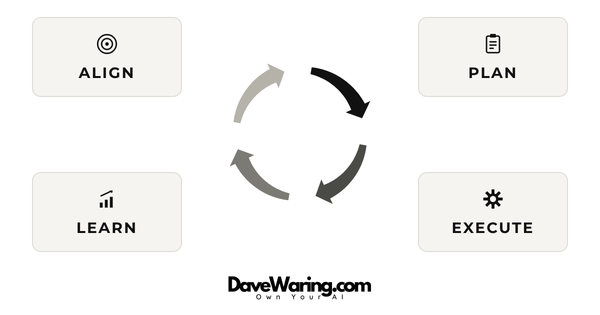
This is where the work now lives. Setting up your knowledge factory, reviewing its output, and identifying where it can be improved.
Only this time, instead of fixing the thing yourself, fix the knowledge factory that produced it instead.
This is the flywheel of improvement that continuously improves your knowledge factory.
And how you succeed in the AI powered future.
Thanks for reading.
Dave
P.S. If you’d like these posts delivered to your email, you can sign up for free here.