The Personal AI Architecture

Today I am pleased to announce the release of the Personal AI Architecture, an open source blueprint for building user-owned AI systems.
The Personal AI Architecture has 1 goal:
To put the power of AI in the hands of the people.
It does this by separating the things that make an AI system personal — your conversations, your preferences, your private data — from the application.
This enables you to always remain in control of your personal data.
And it ensures the power of the AI system you rely on compounds for you, instead of a Big Tech company.
Here's what we are releasing today:
- An in-depth overview of The Architecture.
- A free template for building your personal AI system using The Architecture.
- BrainDrive, the first example of a personal AI system built using The Architecture.
Here's how it works
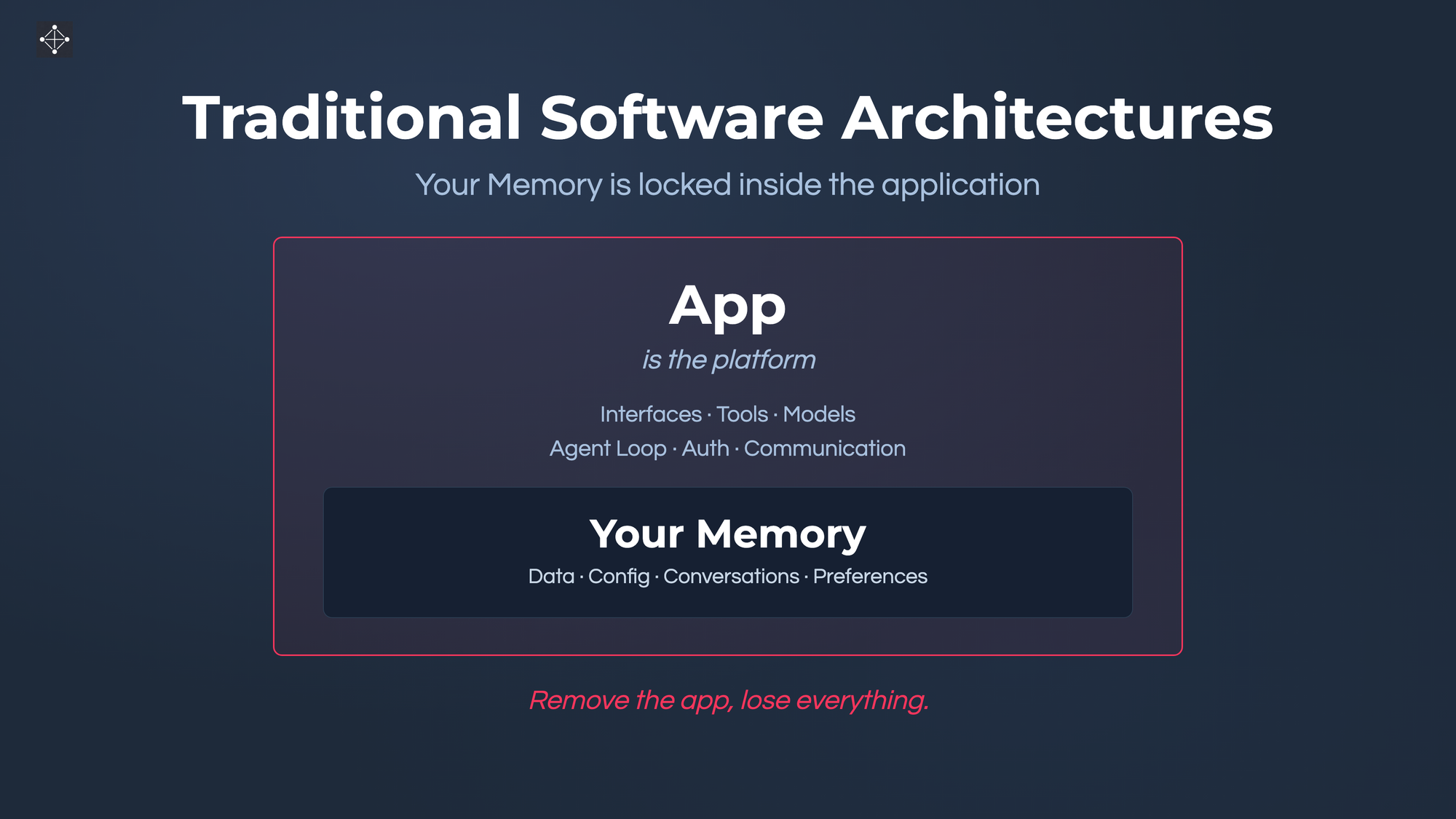
In traditional software, the things that make the system personal to you — your conversations, your preferences, your private data — are tied to the application.
I refer to these things as Your Memory, and this is what gives Big Tech their power.
Their application is the platform, and Your Memory is locked inside it.
The Personal AI Architecture flips how software is architected.
It separates the things that make an AI system personal to you — Your Memory — from the application.
Your Memory is the platform.
And The Architecture ensures you always own and control it.
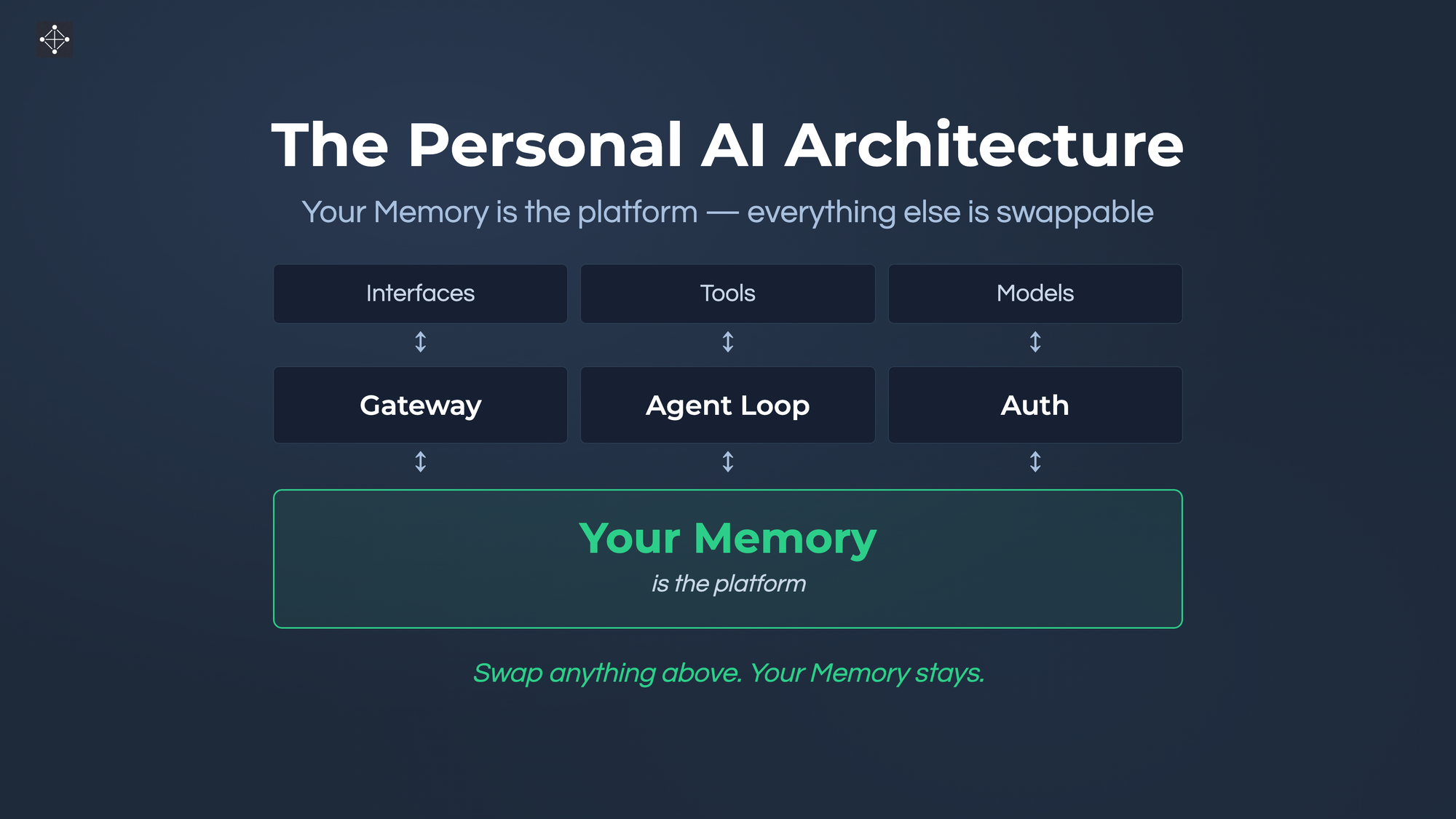
This shifts the power away from the Big Tech application provider, and puts it back where it belongs — with you.
Why this is possible now
Prior to AI, it was not possible to separate Your Memory from the application.
The application provided the intelligence needed to make Your Memory useful. (This is what code is.)
AI changes this.
With AI, you no longer need to build intelligence into software applications.
You can plug intelligence into applications like you plug a lamp into electricity.
And because intelligence can now be separated from the application, so can Your Memory.
This allows us to dramatically simplify how software is architected.
It's hard to overstate how profound a shift this is.
It means we no longer need huge tech companies to build, own, and control the applications we rely on.
We can build, own, and control them ourselves.
Here's how simple it is
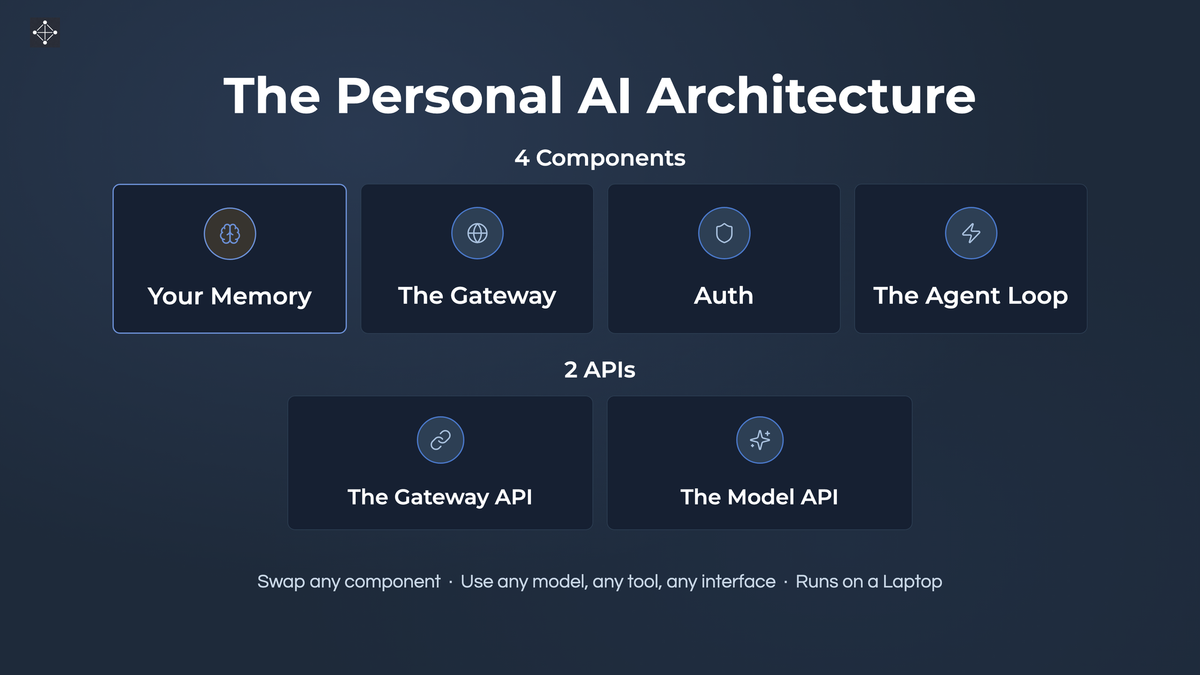
The Personal AI Architecture has just 4 components and 2 APIs.
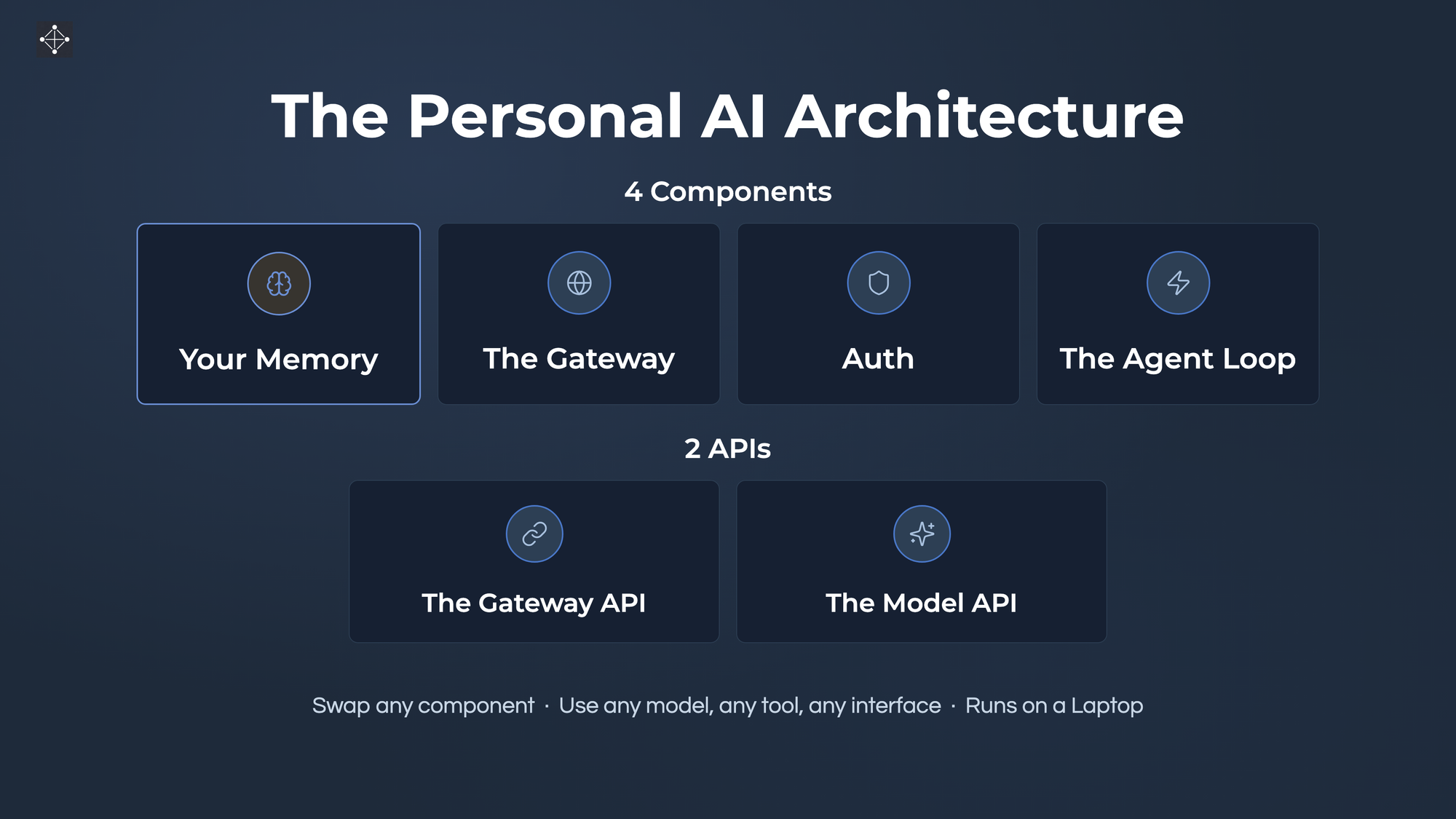
The 4 Components:
- Your Memory — Your data, preferences, configuration, conversations, tool definitions. Everything that makes your AI system personal to you.
- The Gateway — The front door of your AI system.
- Auth — The guard. Decides who can do what.
- The Agent Loop — Talks to the AI model, executes tools, repeats until the work is done.
The 2 APIs:
- The Gateway API — How apps and interfaces connect to The Gateway.
- The Model API — How your system connects to AI models.
Infinitely Extensible
Systems built using the architecture can use any available interface and any AI model.
And new features and functionality arrive via tool calling, not by adding code to the codebase.
This means the Personal AI Architecture absorbs the existing open source ecosystem, instead of having to build a new one from scratch.
Zero Lock-In
Every component is completely decoupled and swappable. This means there is no lock-in, even to the system itself.
Built for individuals
The Personal AI Architecture is simple enough for 1 developer to build on.
And it's small enough to run on a personal laptop.
No Big Tech dev teams or data centers required.
Why this matters
Big Tech AI systems like ChatGPT give us free access in exchange for our personal data and context.
The more we use their systems, the more reliant on them we become.
Power and wealth concentrates, because we live in a knowledge economy, and they control our knowledge.
The Personal AI Architecture offers a better alternative.
An alternative where the individual owns, controls, and benefits from the AI systems we use.
Where the power and wealth created by AI flows far and wide, instead of being concentrated in the hands of a few Big Tech companies.
How you can help
If you are technical, explore The Architecture and build your own AI system using the template.
Both repos are AI friendly, and vibe coders are welcome. Let me know how it goes, and how we can improve.
If you are non-technical, take my free course on user-owned AI, try out BrainDrive, and let me know what you think.
BrainDrive is free to run on your own computer.
It's built to make it easy for anyone to own their AI system, regardless of technical experience.
Thanks for reading.
Dave