Your Memory is the Platform


Big Tech platforms dominated the last phase of the internet.
Their model is straightforward:
- Create compelling software.
- Make it easy to build on their software (make it a platform)
- Leverage network effects to lock users and builders into their platform
- Extract the majority of the value created on their platform.
This model is so successful that all 5 of the most valuable US companies are platform owners.
Many people believe that AI will follow the same Big Tech platform playbook.
I believe they are wrong.
AI unbundles intelligence from the application.
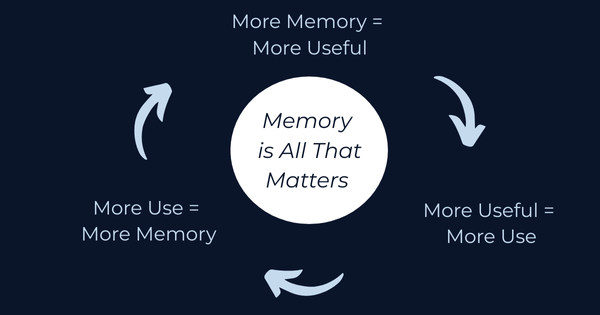
And this shifts the power of the platform from the application, to the memory.
This means you no longer need companies to build platforms for you to use.
With AI, Your Memory is the platform.
What is "Your Memory"?
Your Memory is everything that makes the AI system you use unique to you.
This includes your chat history of course.
But your chat history is just the beginning.
It's the documents you have fed your AI system, and the ones you have created with it.
It's the internet searches you have asked it to complete and the results it has given you.
It's the preferences for how you like to work with the system that you have either explicitly set within the system, or that the system has inferred.
It's the custom prompts and skills you have built into and use in your system.
It's the custom workflows that you have built so the system can execute work on your behalf.
The more you use an AI system, the more differentiated from other AI systems that system becomes.
Not because the interface or the model is different from anyone else's.
But because the system is evolving based on Your Memory.
Your Memory is not new.
I use the same Facebook platform that you do.
But mine is different from yours because of how I use it, and what the Facebook platform knows about me.
So what's changed?
Prior to AI, you could not separate the intelligence from the application.
This meant Your Memory had to be part of the application in order to be useful.
This dynamic is what has made Big Tech Big Tech.
You needed companies to build intelligent applications for you to use.
The more you used those applications the more of Your Memory they held.
And the more locked into those applications you became.
But AI flips this dynamic on its head.
AI models mean intelligence no longer has to be built into, and offered to you via a software application.
Instead of using an App that has the intelligence built into it, you talk to an AI model which is the intelligence.
What's left over from the app, is Your Memory.
And that can now exist separately as well.
This shifts the power from the intelligence, to Your Memory.
As anyone who uses AI extensively can tell you, the primary differentiator between their AI system and someone else's, is not the AI model that powers it.
It's their specific setup, context, workflows, skills etc that are the differentiator.
What we refer to as "Your Memory".
Example:
Garry Tan, the CEO of Y Combinator, recently open-sourced his entire AI setup as a GitHub repo. Twenty-eight custom skills, workflows, and operational tools that he's built on top of Claude Code.
He reports shipping over 600,000 lines of production code part-time, while running YC full-time.
Could he have done this without the AI model? No.
But Claude is the electricity. Essential, but not where the value lives.
The differentiating value came from the skills and workflows he built. His memory.
And because it exists as files, not as features inside an app, he owns it. He can share it. He can move it. He can plug it into whatever comes next.
No permission needed.
And each of these things can now exist separately from the application.
In fact not only is this possible, but it makes everything dramatically better.
Here's why:
Your Memory compounds instead of fragmenting.
Today, every app you use holds a piece of Your Memory.
Your email knows your contacts.
Your project tool knows your tasks. Your iMessage knows your conversations.
But none of them know about each other.
Every new app you adopt is another silo. Your Memory doesn't grow, it scatters.
When Your Memory exists in one place, every interaction makes the whole system richer.
A text thread you had last month informs a document you're writing today.
Updating a task updates all the other documents, dependencies and stakeholders automatically as well.
A decision you made in one context is available in every context.
Nothing is lost in the gaps between applications.
Your Memory stops fragmenting and starts compounding.
Software comes to you.
Today, you travel from platform to platform.
You go to the email app.
You go to the calendar app.
You go to the project management app.
Every new app is a blank slate. You sign up and choose and quickly forget another password, and input the exact same info you have input a hundred times before into all the other apps.
When Your Memory is the platform, you don't go to the software. The software comes to you.
New model? It has your full context on day one. New tool? It connects to everything you've already built. New interface? It already knows your preferences, your history, and the way you think.
The thing that took months to build — Your Memory — carries forward automatically.
You never start over.
You're free to use your system however you please.
When you live inside someone else's platform, you're a tenant. You play by their rules and you get the features they choose to build.
When Your Memory is the platform, you're the owner.
You decide what tools to use.
You decide what models to run.
You decide how your system works, what it prioritizes, and what it ignores.
Nobody else's product roadmap dictates how you work.
Your system evolves at the speed of AI.
Right now, you're bottlenecked by each app's release cycle.
A better model ships tomorrow, but you can't use it until your app integrates it.
A new capability emerges, but you wait months for someone to build it into a product.
When Your Memory is the platform, that bottleneck disappears.
New model? Plug it in.
New tool? Connect it.
New capability? Use it today, not whenever some product team gets around to it.
Your system isn't waiting on anyone's roadmap. It evolves as fast as the technology does.
Value flows to those who create it.
The Big Tech platform model leverages platform lock-in to extract value.
You create content on their platform.
You build workflows on their platform.
You grow your audience on their platform.
And they take a cut of everything — or worse, they take the data itself and monetize it without you.
When Your Memory is the platform, the lock-in that enabled that extraction is gone.
Your Memory is no longer locked inside a Big Tech platform.
This means the value you create stays with you.
The context you build compounds for you.
The workflows you develop are yours to keep, share, or sell.
Value flows to the people who create it, not to the platform that happened to host it.
The evidence is growing.
I'm not writing this as a prediction, but as a witness to evidence that is already here.
Developers are already building their memory outside of applications — custom skills, workflows, tools, and markdown knowledge bases. All outside of any single app.
They're building their memory as a platform whether they call it that or not.
The open source community has already built the pieces, the models, tools, and interfaces are all out there.
What's missing is an architecture that unites them around the new center of gravity: Your Memory. (See The Personal AI Architecture for my proposed architecture.)
The question isn't whether memory becomes the platform.
The question is whether you own yours.
When Big Tech platforms own Your Memory, power concentrates.
A handful of companies control the context, capture the value, and set the rules for billions of people.
When you own Your Memory, power decentralizes.
Value flows to the people who create it.
The compounding benefits of AI flow far and wide instead of concentrating inside a few Big Tech platforms.
Your Memory is the platform.
And it should be yours.